
Implicated for Love's Sake
On Steven Garber's Hints of Hope
Once, a great storyteller was in a toolshed, observing a beam of light through a hole; noting the floating dust particles, the contrast of the light and pitch blackness around it—
…Then I moved, so that the beam fell on my eyes. Instantly the whole previous picture vanished. I saw no toolshed, and (above all) no beam. Instead I saw, framed in the irregular cranny at the top of the door, green leaves moving on the branches of a tree outside and beyond that, 90 odd million miles away, the sun. Looking along the beam, and looking at the beam are very different experiences. ¹
—and C.S. Lewis proceeded to create a metaphor. Personally, I find myself looking at the beam of light. Thinking about faith. Writing about creativity, myth, and metaphor. Thinking about the meaning of life and vocation. But every now and then, however accidentally, I found myself stumbling into the beam of light and staring into the sun. For a split second, and not much longer, I can see God, and in that seeing, myself.
I can’t tell if Steven Garber’s book, Hints of Hope nudged me into the light, or poked a new hole in the shed. In some ways, I think both.
My wonderings about faith and vocation are not new. At best, they are thoughtful, at worst, they are over-thoughtful. Some might say these wonderings are the byproduct of a generation, at least a byproduct of your twenties. But not Garber.
These questions, which are one question, asked or not asked, are the great questions of every life—and they must be answered, requiring that we press in more deeply, exploring the necessary relationship of metanarrative to narrative, of the Story we believe that makes sense of life, and the story of our own lives. The answers, necessarily, will be proximate, seeing through a glass darkly as we do; but weighty as they are, that we ask them, and then answer, matters; it matters very much. ²
Garber picked up fragments of questions over the years, Who am I?, Why am I?, What do I want to do with my life? and pieced them together, added new material, and story by story, essay by essay, constructed a cathedral around “what it means to be human” of which the pinnacle is our vocation. The price of admission is not cheap, it requires something of you, and at the right time, it may require your life. But the reward is great, for in it we discover God and ourselves.
At the foundation of this cathedral, at the foundation of all of life, there must be something that can bear the weight of such lofty claims. There must be. The foundation of life and vocation can’t be naked ambition, it can’t be pure meaninglessness. Life has a particular “shape and aim,” not just for the individual, but for the collective. There is a right way and a wrong way to live, “we can call it what we want to call it, what we cannot do is live for long as if it is not true, because it is beyond our choosing or preferring, reality as it is.” And in this reality, Garber teaches us that we are implicated in world around us. Responsible, for love’s sake, for the way the world is and ought to be.
This is not just for the moral person. It’s for the human person. And virtues, or “habits of the heart” that manifest in the push and shove of everyday life, are defining traits of what it means to be human, and they are an essential ingredient for flourishing. Vices, on the other hand — pride, arrogance, self-absorption — don’t just make for worse individuals, they make less human societies, polities, and economies.
A beautiful vision, but one honest look at the human condition and we see that the call to virtue alone is not enough. In part because we fall short of what is required. Garber says, “For the honest, sensitive soul, this is crushing… especially when it is ‘a good man’ that we aspire to be.” The Greek tradition gave us duty, “both to delight in and to be pained by the things that we ought,” a telos, a praxis; but without a grounding in grace, we are crushed under it’s weight. Something more is needed. Something that makes sense of moral life, all of reality, for everyone, everywhere—”every square inch.” In this honest desire to know, to make sense of our life and the world, Garber leads us to the Hebrew-Christian tradition by way of Old Testament epistemology.
The Hebrew word for “know” is used hundreds of times throughout the Old Testament, and is unique because it is the same word to describe, “Adam knew Eve his wife,” that is used to make sense of, “The righteous man cares about justice for the poor, but the wicked have no such concern.” The same Hebrew word, yada, describes the deepest intimacy and vulnerability and it describes a necessary implication of one’s life in the world.
As Simone Weil once noted, “It is learning ‘to know’ that is central to human being.” And artist among artists, Makoto Fujimara says, “The deepest realm of knowledge is in Making, and, conversely, Making is the deepest integrated realm of knowing.”³ This is essential to human being — not just the vocationally curious individual. Garber and Weil and Fujimara teach us that we must enter into, for it’s possible to know about, and yet not truly know. Only when we do, only when we see ourselves implicated for love’s’ sake, do we begin to know.
It is not lost on me that “The one who knows the most mourns the deepest,” yet some of us choose to love deeper still. Not in spite of the crushing weight of duty, but because of a grounding in grace.
We begin to know by making, by hearing, by seeing, not unlike our seeing when we look along the beam of light into the sun ninety million miles away. In this act of seeing, our faces are made brighter, warmed by the light. Perhaps too with all forms of knowing we are “acted upon” by something more good, more true, more beautiful—and we respond.
For Garber, we respond by making peace with the proximate, “For some good. For some justice. For some happiness. For some mercy. For some beauty. Real and true and right, each one, and yet never everything.” This is central to Garber’s way of seeing, and the way he makes sense of all things, for these things are—perhaps more, but not less—signposts for when we no longer see through a glass darkly, but then face to face. Now I know in part, but then shall I know even as also I am known.
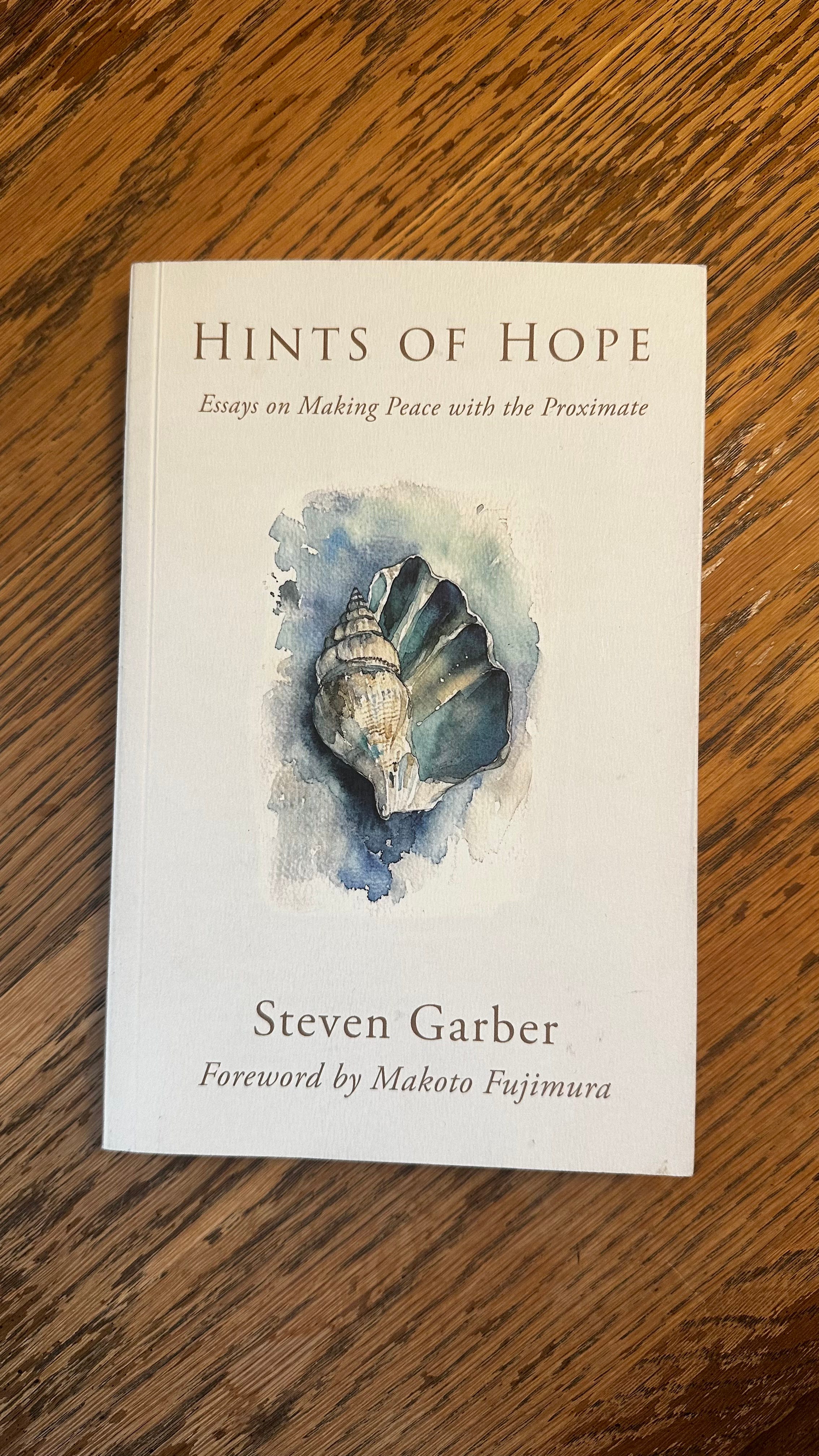
Link to buy the book: https://paracletepress.com/products/hints-of-hope
¹ C.S. Lewis, “Meditation in a Toolshed,” in God in the Dock (1945).
² Quotations and paraphrases throughout are from Steven Garber, Hints of Hope (2026), especially pp. 52, 57–60, 73–74, 103, and 270.
³ Makoto Fujimura, Art + Faith: A Theology of Making (2020).